StressEraser
Mini Case Study
The challenge
The challenge was how to simplify the complexities of biofeedback training so that the non-technical person could easily master it. If this had been a web-oriented task, the user story may well have been "As an EMT, I need to easily learn how to regulate my stress response because I must function well on the job."
The approach
- Audit and task analysis: I analyzed how I learned to use this product and took detailed notes on pain points.
- Information mapping: I extracted basic processes and presented them in a clear, orderly fashion, similar to a quick start guide.
- Logical sequencing: I structured the manual to follow the user's natural progression from unboxing to troubleshooting.
Information architecture
I learned that Table of Contents sections tend to follow a basic expected framework. With that information, I researched various Table of Content sections of electronic products manuals. I shaped the StressEraser table of contents, removing, adding or reshaping sections to reduce jargon and cognitive overwhelm. The Instructions section lent itself to the feel of a quick start guide so I did not create a separate quick start guide—detailed nuances and technical depth went to the Technical Description.
The solution
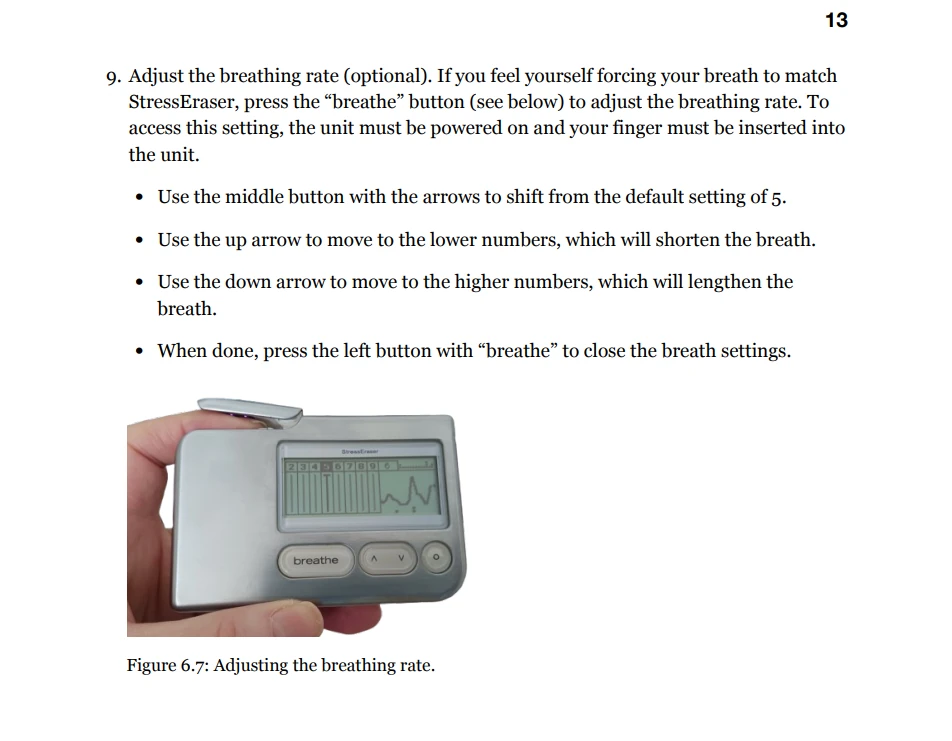
Within each major section, I conveyed content hierarchy with appropriately sized subheadings, lists and indentations. I supplemented complex instruction with photographs and paid careful attention to white space. And within each section, I restarted the Figure numbering to ease maintenance of the manual, e.g. the first figure in section 3, would be 3.1.
The result
A clear step-by-step guide that provides the user with frustration-free mastery.
© 2025, Carol Robertson